Shift Report #4
Visibility Matters Not If You Don't Really See Yourself
OWNERSHIP
Shawn C. Parker
6/14/20265 min read
Visibility Matters Not If You Don't Really See Yourself
The Visibility Trap
There is a particular kind of professional woman who is never invisible. She is recognized, cited, pulled into rooms, consulted on decisions. Her name gets mentioned when the right opportunities arise. By every external measure, she is seen.
And yet, she cannot tell you with precision what she actually wants, what she is actually worth, or what she would build if she were building for herself. This is not a contradiction.
It is one of the most common patterns among high-performing Gen X women — and it is the thing that keeps external visibility from ever converting into owned equity.
The LinkedIn Connector and the Laundry List
I was networking on LinkedIn when I connected with a man who described himself in his bio as a "connector" of people. He reached out, said he had some contacts, asked if he could help. Standard opener. Then he asked what I do.
I told him. All of it. I had built the YogaSkills course, the website, the community, the blog, the podcast. I handled social media, marketing, tech support. I listed it the way you list credentials when you are proud of the range — because I was. I thought it was impressive.
I remember he said: "You're too dope. No one knows what to do with all that."
My response, almost reflexive: "Oh wow, it's okay — I'll figure it out." He followed up with "I was just teasing" and moved on.
But I stayed with what had just happened. Because in that exchange I had done two things without thinking: I had performed my value in a way designed for someone else to categorize it, and then I had apologized for being uncategorizable.
That was the corporate indoctrination talking — the belief that breadth is a liability, that a narrow lane is the only lane that counts. I had internalized it so completely that when someone challenged it, even as a joke, my first move was to make myself smaller.
The truth I knew but hadn't yet named: I had wanted to be an entrepreneur since I was a kid. I just didn't have that word for it then. In 2000, I read Rich Dad Poor Dad by Robert Kiyosaki and something clicked into place. I knew I wanted to be in the B/I (business owner/investor) part of the cashflow quadrant.
I've been learning how all the parts of a business work — to operate, not just execute. That reframe changed what my range meant. My polymath mind was never the problem. It was always the architecture. It just needed an era that could use it.
That era is now.


AI and the Mirror Problem
AI does not solve the internal visibility problem — but it surfaces it immediately. When you sit down to use AI to build an offer, write content, or articulate your expertise, the first thing the tool requires is that you describe what you know, what you do, and who you do it for. In clear terms. Without the institutional shorthand.
Women who have strong internal visibility can do this in minutes. Women who have only external visibility discover the gap right there, in the prompt field, when the cursor is blinking.
AI is not a shortcut around self-knowledge. It is an amplifier of it.
What this means: before you can leverage AI to build anything real, you have to be able to see yourself clearly enough to give it accurate raw material.
The Real Shift
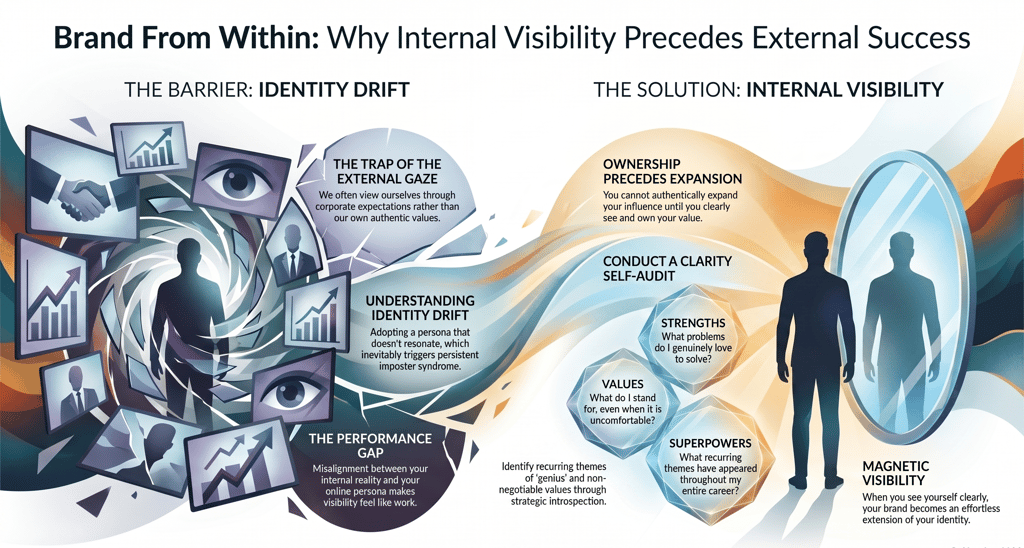
External visibility built your reputation inside a system someone else designed. Internal visibility builds the foundation for everything you are about to own. The shift is not about becoming more visible to the world. It is about becoming more visible to yourself first.
Seal the Shift: Action Step
Use this prompt to begin mapping the gap between how others see you and how you see yourself. Most professionals have never done this exercise, and the results are clarifying.
The Prompt: I want to understand the gap between my external reputation and my internal self-concept. Ask me five questions — one at a time — that will help me articulate what I actually know, what I actually value, and what I would build if I were building entirely for myself. Do not let me answer in job titles or corporate language. Push me to be specific.
Work through all five questions. The places where you struggle to answer without defaulting to institutional language are exactly where the internal visibility work needs to happen.


Internal vs. External Visibility
External visibility is the currency of the corporate world. It is who knows your name, who vouches for you, who thinks of you when a seat opens. It is real and it has value — but it is value that belongs to someone else's ecosystem. The moment you leave that organization, the room, the title, most of that visibility leaves with you.
Internal visibility is something different.
It is the clarity you have about your own expertise, your own standards, your own direction. It is knowing what you would say if you were asked to define your work on your own terms rather than your employer's.
Most women in transition discover they have an abundance of external visibility and a startling deficit of the internal kind. They know exactly how to describe their value in someone else's language. They have never been asked to name it in their own.
The Ownership Precondition
Law 1 of the Shift Doctrine states that Ownership Precedes Expansion. What I have come to understand is that ownership of your work cannot begin until you can see your work clearly — on its own terms, outside the frame that any institution gave it.
You cannot own what you have not named. You cannot expand what you cannot yet describe. The women who get stuck in transition are not stuck because they lack capability. They are stuck because the only mirror they have ever used to assess themselves belongs to someone else.
Someone else's performance review. Someone else's org chart. Someone else's definition of what "senior" means.
The Pattern That Keeps It in Place
Generation X was trained to earn visibility, not claim it. You demonstrated value, you waited to be recognized, and recognition came in the form of a title, a raise, a seat at the table.
That system taught us to be good at being seen. It never taught us to be the ones doing the seeing.
The result is a generation of women who are extraordinarily good at performing for an audience and genuinely uncertain about who they are when the audience isn't watching.
"You can be the most recognized person in the room and still have no idea what you actually see when you look at yourself."


Home | About | Shift Report | Contact


The world changed. We help you move with it.
Copyright © 2026 Real Shift Digital. All Rights Reserved