The Shift Report #1
Why Having 50 Jobs Was the Best Thing That Ever Happened to My Career
TECHNOLOGY
Shawn C. Parker
4/26/20266 min read
Why Having 50 Jobs Was the Best Thing That Ever Happened to My Career
The Myth of the "Broken" Worker
For decades, a resume featuring 50 different jobs was viewed as a forensic record of failure. In the industrial-era "worker bee" model, such a history suggested a lack of commitment, a deficit of focus, or a fundamental inability to fit into the gears of corporate machinery.
Society labels this systemic misalignment as a personal defect, convincing high-achievers that if they haven't found their "forever home" in a cubicle, they are somehow broken. However, having 50 jobs — actual W-2 positions with managers and performance reviews — is not a sign of a scattered mind; it is an early indicator of algorithmic obsolescence.


This tension between working hard and constantly starting over isn't a sign of unreliability. It is a signal that you were trying to survive in a model that no longer matches the reality of the modern economy. Those transitions weren't failures; they were the results of pattern recognition without a framework — the intuitive sense that the old rules of work were crumbling long before the rest of the world noticed the cracks.
Practicality is Often Fear in a Suit
In 2008, I was working at LA City Hall for Councilmember Bernard Parks. It was a "good" job by every external metric. During my first week, the Chief of Staff sat me down to discuss the perks: health benefits, stability, and the holy grail of the old world — a guaranteed pension after ten years. In the middle of the Great Recession, that word should have sounded like safety. Instead, my immediate internal reaction was: there is no way I am staying here for ten years.
That moment revealed a profound truth about the "Fear Loop." We often grab the next reasonable option because we are afraid to pause and decide what we actually want. This survival instinct is persuasive because it masks its cowardice as maturity.
That’s how fear hides. It doesn’t show up screaming. It shows up dressed as practicality. As being realistic. As not rocking the boat. When we choose a role solely for the "pension" or the "stability" we are holding onto the shape of security without the substance of it. True strategic advantage requires moving beyond these reactive defense mechanisms.
You Aren't Scattered, You're a Polymath
Later, at a district event, I sat with Nate Holder, a former councilmember and elder in LA politics. He asked if I was campaigning for the Councilmember’s historic run for County Supervisor. I gave him a practical answer about being a single mom and needing to get home. He looked right through me and said, "You have no fire for this job, do you?" He saw what I couldn't yet name. I wasn't "unfocused" — I was a polymath trying to survive in a system built for specialists.
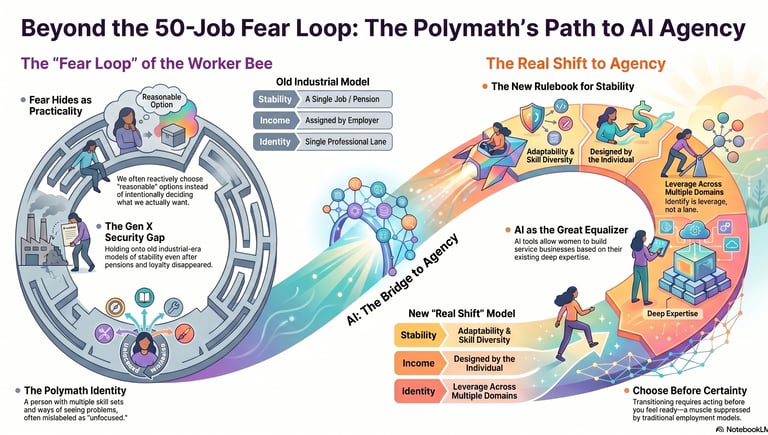
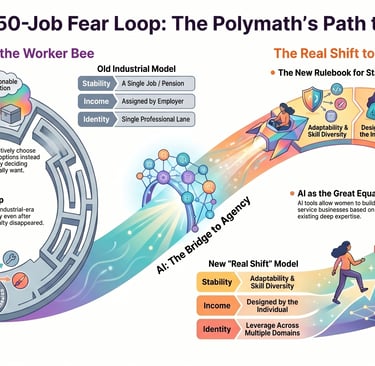
A polymath possesses multiple skill sets and excels at synthesizing information across disciplines. Traditional corporate environments struggle to categorize these individuals, often labeling them "unstable" because they don't fit into a single lane. I was raised to be a responsible worker bee, but my nature was never designed for hive life .
If you have spent years trying to compress your versatile, multi-dimensional mind into a specialist’s box, you haven't been failing to focus—you’ve been trying to force a high-performance engine to run on a treadmill.
The Gen X "Boomer Clone" Trap
Generation X occupies a unique, precarious position, caught between the industrial era and the tech age. Many of us became "baby boomer clones," clinging to an old economic model even as the floor shifted.
The Dot Com bust spooked an entire generation, causing us to grip our traditional jobs even tighter out of trauma. The tragedy is that we held on while the pension disappeared and corporate loyalty evaporated. We have been playing by a rulebook for a game that no longer exists.
The Economic Rules Have Changed:
The Old Rulebook: Valued safety, sought clarity before moving, and waited for permission from the hierarchy.
The New Reality: Values adaptability, requires designing income rather than having it assigned, and uses identity as leverage. Hard work is no longer a shield against systemic change. At best, it is a stay of execution. The only real security is the ability to pivot.
Wanting is Not the Same as Deciding
Many professionals spend their entire lives wanting agency, wanting ownership, and wanting to build. But there is a canyon between wanting and deciding. The worker model atrophies our decision-making capabilities; it trains us to wait for certainty before we strike. Entrepreneurship, however, is a muscle trained by choosing before certainty .
This is the fundamental skill the "worker bee" model actively discourages. Waiting to feel "ready" is an efficiency trap designed to maintain the status quo of the institution. You can want something your entire life and never actually choose it.
Real career shifts happen only when the passive desire for a different life is replaced by an active, intentional decision to exercise your agency, regardless of the absence of a safety net.
AI as the Great Equalizer for Expertise
For the women who felt left behind by previous technological shifts, Artificial Intelligence is the ultimate vehicle for latent expertise. We are moving from a world of assigned income — where a company dictates your value — to designed income, where you leverage your accumulated wisdom through digital tools.
AI isn't just about "asking a bot questions"; it’s about the ability of seasoned professionals to build service businesses from their decades of real-world skills without the need for a massive technical team. In this new chapter, curiosity is a more valuable currency than traditional talent.
AI tools allow the polymath to scale their diverse knowledge into a cohesive, leveraged enterprise.
Conclusion: The Real Shift
Stability is no longer a job title; it is your capacity for adaptability. Having 50 jobs wasn't a sign of a broken career for me — it was a 20-year case study in the failure of the old system. If you have felt "too much" for a single role, it is time to stop looking for a job and start looking for a new set of rules to play by.
Seal the Shift: Action Step
To begin dismantling the outdated rules you’ve been following, use the following prompt with an AI tool like Claude or ChatGPT to audit your current career logic:
AI as the Great Equalizer for Expertise
For the women who felt left behind by previous technological shifts, Artificial Intelligence is the ultimate vehicle for latent expertise . We are moving from a world of assigned income —where a company dictates your value—to designed income , where you leverage your accumulated wisdom through digital tools.
AI isn't just about "asking a bot questions"; it’s about the ability of seasoned professionals to build service businesses from their decades of real-world skills without the need for a massive technical team. In this new chapter, curiosity is a more valuable currency than traditional talent. AI tools allow the polymath to scale their diverse knowledge into a cohesive, leveraged enterprise.
Conclusion: The Real Shift
Stability is no longer a job title; it is your capacity for adaptability . Having 50 jobs wasn't a sign of a broken career—it was a 20-year case study in the failure of the old system. If you have felt "too much" for a single role, it is time to stop looking for a job and start looking for a new set of rules to play by.
Seal the Shift: Action Step
To begin dismantling the outdated rules you’ve been following, use the following prompt with an AI tool like Claude or ChatGPT to audit your current career logic:
The Belief Audit Prompt: I'm going to share some beliefs I have about work, money, and stability. Tell me which ones are outdated based on how the economy actually works today, and why.
Here are my beliefs:
List your beliefs here, e.g., 'I need a 10-year plan,' 'My value is tied to my job title,' 'Safety comes from a W-2.'
Read the response. Engage with it. The first step toward the future is identifying which parts of your "practicality" are actually just fear in a suit.
That is where the real shift begins.


Home | About | Shift Report | Contact


The world changed. We help you move with it.
Copyright © 2026 Real Shift Digital. All Rights Reserved